
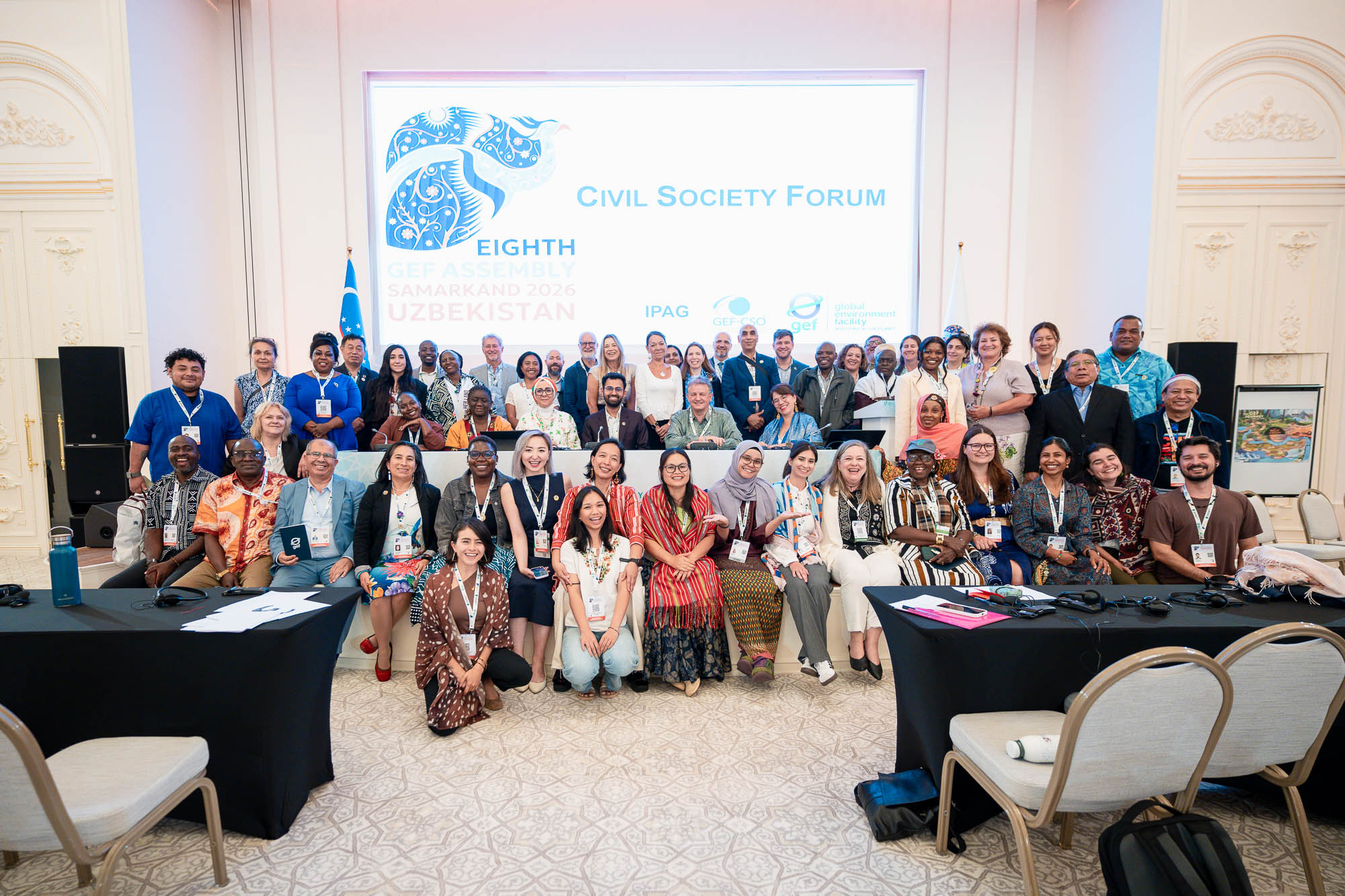
SAMARKAND, 6 June 2026: Civil society representatives from across the world today called on the Global Environment Facility (GEF) and its member governments to deepen their partnership with civil society and significantly strengthen support for community-led environmental action.
Global Environment Facility Civil Society Organization (GEF-CSO) Network Chair, Faizal Parish delivered this message at the opening of the 8th Global Environment Facility (GEF) Assembly, in Samarkand, Uzbekistan on June 4, 2026. Faizal, who is also Malaysian-based Global Environment Centre’s founder and director, has been serving as the Chair of the Network since 2024.
Speaking on behalf of civil society, he said the statement he delivered reflected the collective views of over 200 participants of the GEF Civil Society Forum held in Samarkand on June 3, 2026.
Stressing that “we have mistreated Mother Earth for hundreds of years,” Faizal Parish underscored the collective responsibility to change business-as-usual practices in project design and implementation by fully engaging CSOs.
Civil society representatives emphasized that the world is facing an unprecedented convergence of environmental and social crises, including climate change, biodiversity loss, land degradation, pollution, freshwater scarcity, and widening inequalities.
These overlapping challenges, they noted, are undermining human well-being and threatening progress toward the Sustainable Development Goals (SDGs).
The statement highlighted the pivotal role of civil society organisations (CSOs), Indigenous Peoples, local communities, women, and youth in safeguarding ecosystems, managing natural resources, and advancing sustainable development. It stressed that the scale and complexity of today’s environmental crises require inclusive, cross-border, and whole-of-society responses.
Faizal noted that “the only way forward is collaboration,” stressing the GEF must progress further toward viewing civil society as not just beneficiaries, but as actors, rights holders, and partners.
Civil society commended the Facility’s commitment to direct 20% of GEF-9 programming toward actions led by Indigenous Peoples and Local Communities (IPLCs), as well as efforts to improve funding mechanisms, policies, and guidelines to better respond to the needs of civil society, IPLCs, women, and youth.
“This is a significant milestone in recognising the central role of rights-based, community-led conservation and sustainable development,” as highlighted in the statement.
Key Calls to Action
In the statement, the civil society called on the GEF to transform its partnership with civil society through a series of concrete actions during GEF-9 and beyond:
- All countries that have not yet announced contributions to GEF-9 to make meaningful pledges as soon as possible so that GEF-9 resources at least match, and ideally exceed, those of GEF-8 in line with international commitments.
- A substantial increase in funding for civil society, including broader direct access to financing across the GEF family of funds and stronger integration of civil society components within GEF projects and Integrated Programmes. Access to funding should be flexible, culturally appropriate, adequate, and predictable.
- An expansion of the GEF Small Grants Programme (SGP), including a call for recipient countries to allocate at least USD 200 million (RM803.3 million) from their GEF country (STAR) allocations to strengthen and scale up the programme.
- Deeper civil society engagement in transboundary and regional initiatives, recognising that ecosystems cross borders and that the communities who depend on them must be fully included in cooperation and governance efforts.
- A rights-based approach across all GEF policies and programmes, including action to address historical and regional injustices, secure land tenure for women, and eliminate gender-based violence.
- Greater decision-making roles for civil society representatives at global, national, and project levels, with representatives to be self-selected by civil society.
- Stronger transparency and accountability in the use of GEF funds, including monitoring and reporting on impacts and on the flow of funds to IPLCs and CSOs throughout the full project cycle. Civil society also called for participatory monitoring and the integration of community-generated data into programming and resource allocation.
- Expanded education and capacity-building programmes that draw on the knowledge systems and expertise of civil society. Such support would strengthen civil society’s capacity to design, implement, and monitor GEF projects and help educate present and future generations on protecting the planet.
A Call for Whole-of-Society Action
In closing, civil society called on the GEF and member governments to redouble efforts to work together in an integrated, cross-sector, and whole-of-society approach to address the planetary crisis for current and future generations.
The statement underscored that effective environmental action will only be possible through stronger partnerships with civil society — especially with Indigenous Peoples, local communities, women, and youth — whose knowledge, leadership, and stewardship are essential to achieving lasting impact.
END
For details on all the GEF-CSO Network activities at 8th GEF Assembly: Click HERE